What studying in Bamberg is like
The faculty, the town, the people, and what comes after your studies. This is what module handbooks and tables do not show you.
From eight to more than 30 professors
The Faculty of Information Systems and Applied Computer Sciences (WIAI) was founded on 1 October 2001. Its mix of subjects was unique in the German-speaking world: information systems, applied computer science linked to the humanities and cultural studies, and classic computer science, all under one roof. It started with eight chairs and professorships, but only two were filled at first. There were three degree programmes and 125 students.
Today more than 30 professors teach at the faculty, nearly twice as many as in 2020. Its range of programmes in computer science and information systems is unusually broad for Germany. In the AIS Research Ranking (February 2025), Bamberg came first in Bavaria, third in Germany and fourth in Europe in information systems research.
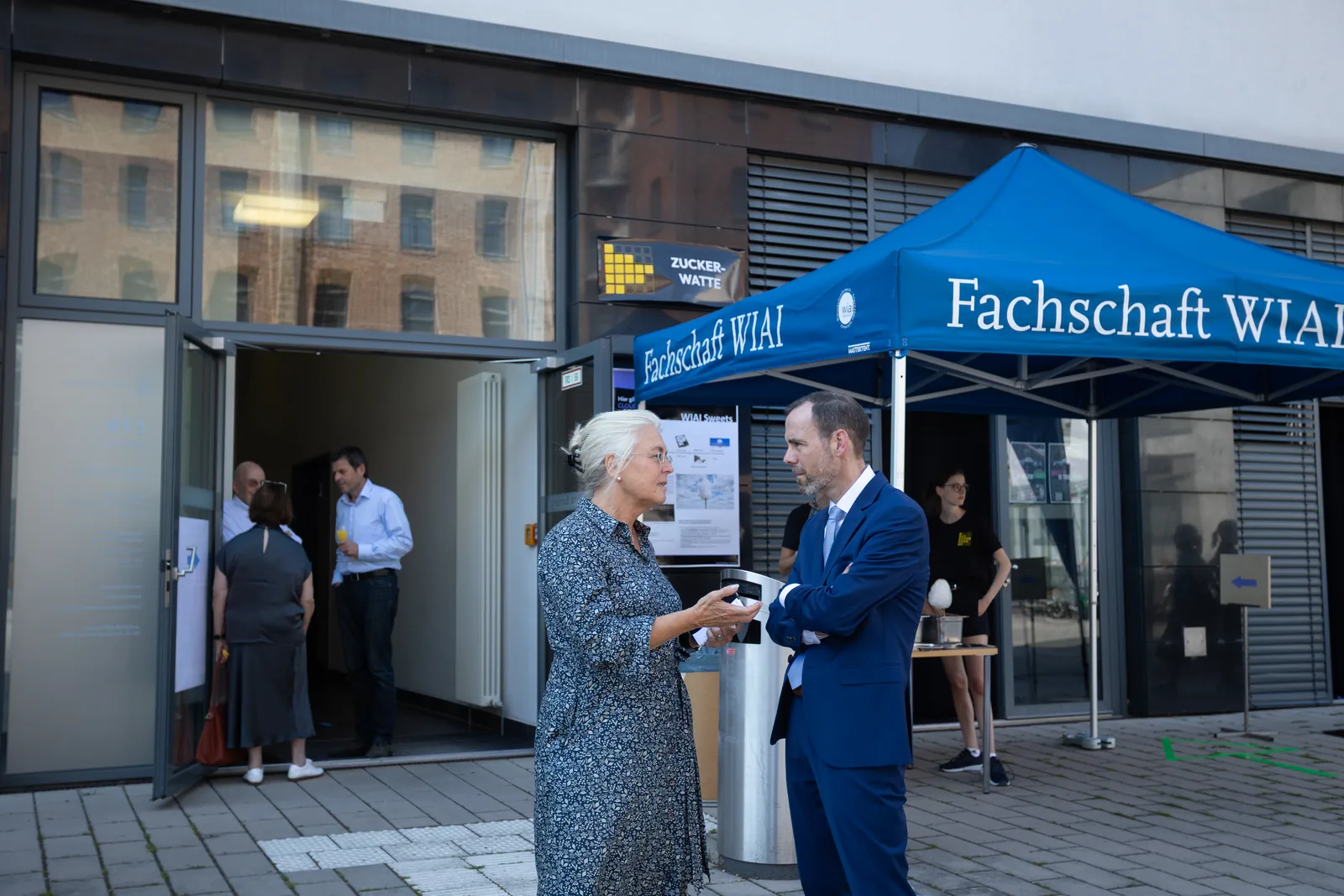
The faculty celebrated its 25th anniversary in June 2026 on the ERBA campus. The anniversary site wiai25.de (in German) tells its history in 25 stories.

A World Heritage town
Bamberg’s old town has been a UNESCO World Heritage Site since 1993.
Town and campus
Seven hills, a river, short distances.
Bamberg lies on seven hills in the valley of the river Regnitz. There are 14 breweries in town. Each has its own tavern or “Keller”, which is what people in Franconia call a beer garden. Distances are short, and you can easily get around by bike. By train, Nuremberg is about 40 minutes away and Munich about 1 hour 45 minutes.
The university’s Welcome Center for international master’s students suggests budgeting €900 to €1,000 a month. This covers rent, food, health insurance and other costs. In 2021, student rents in Bamberg were among the three lowest of Bavaria’s university towns. There are no tuition fees. Every student pays a semester contribution (currently €123.22 per semester). It includes a ticket for buses and regional trains in the town and the district of Bamberg.
The ERBA campus
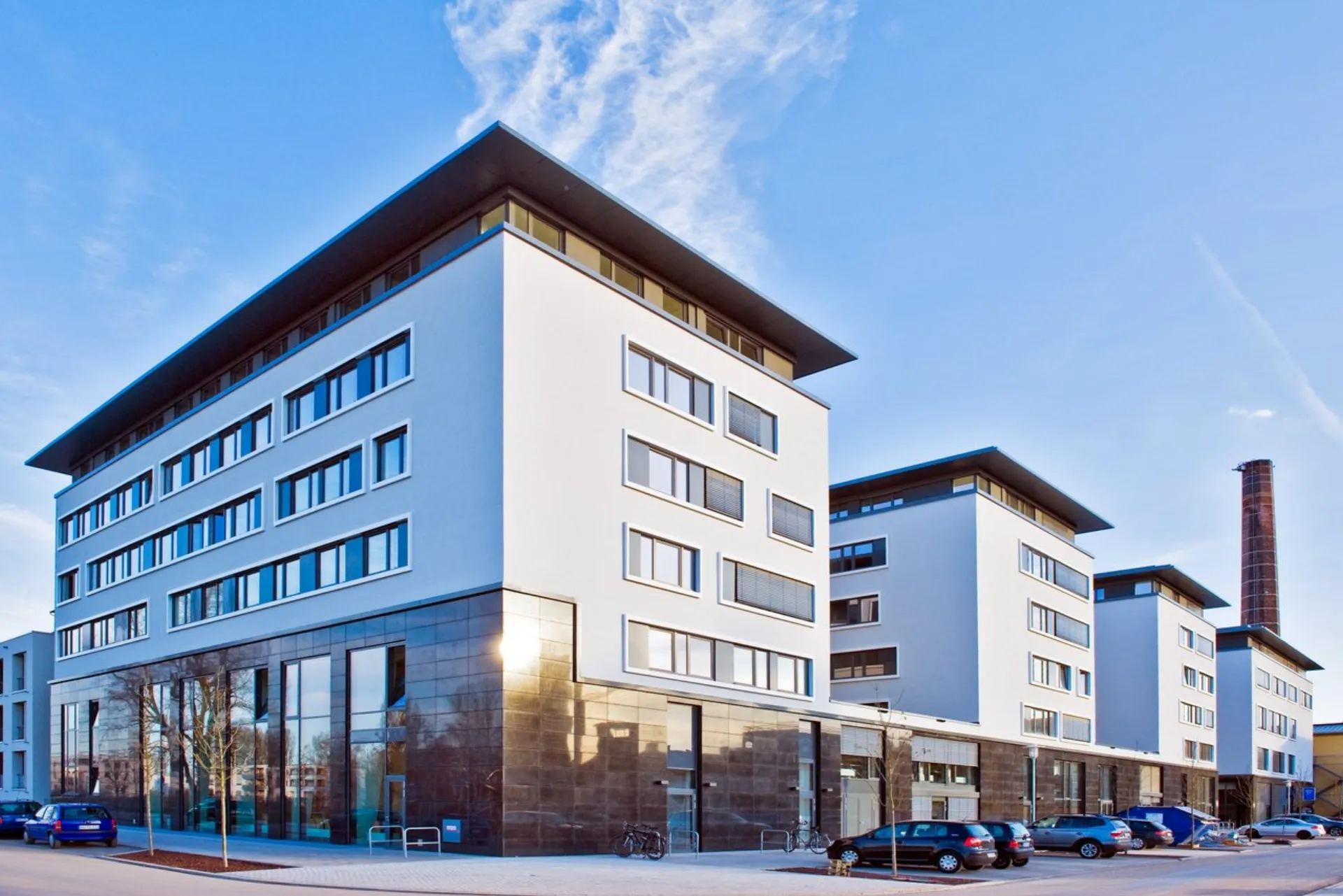
The faculty is on the ERBA island in the river Regnitz. A cotton mill used to stand here, and nearly 2,000 people worked there around 1913. The mill closed in 1993. In 2012, the site hosted the Bavarian garden show, and the faculty moved into a new six-storey university building. The building has a coworking space and a library. You can use the library around the clock with your student card.
“We are not a mass university here in Bamberg. That brings students enormous advantages – small seminar groups, close supervision and many interdisciplinary collaborations.”
Arriving as an international student
Who helps you after admission, and what the first weeks look like.
After you are admitted, international master’s students can turn to the university’s Master Welcome Center (master.welcome-center@uni-bamberg.de). It advises on housing, visas, dealing with the authorities and your first steps.
Orientation days usually take place in the week before lectures start. Many events are in German. You put together your own timetable. Once your student ID is validated, it is also your ticket for the buses in the town and the district.
Once you are enrolled, you can take German courses at the university’s Language Centre. ISoSySc students must prove basic German (level A1). You can hand in the proof until the end of your second semester. If you have not done so by then, your enrolment ends.
Safety and support
How safe Bavaria and Germany are, and where to turn if something happens.
Statewide, Bavaria has the lowest recorded crime rate of Germany’s 16 federal states: 4,371 offences per 100,000 inhabitants in 2025, compared with 6,591 nationwide (police crime statistics).
According to the DAAD (the German Academic Exchange Service), Germany is one of the safest countries in the world. In a 2021 survey, over 80% of international students said they feel safe here. That does not mean nothing ever happens. In an emergency, call the police on 110, around the clock.
If something does happen, you are not alone. The university has trained contact persons for confidential advice on sexual harassment and violence (sbg@uni-bamberg.de). Its Anti-Discrimination Office is at An der Weberei 5, the faculty’s building, and advises in German and English (antidiskriminierung@uni-bamberg.de).
The faculty’s equal opportunities team (wiai.gbwiss@uni-bamberg.de) runs a women’s network, Frauennetzwerk WIAI. Nightline Bamberg is a listening line run by students for students. You can also call it on your way home. The national helpline for women affected by violence is 116 016.
The people
More than 30 professors teach at the WIAI. Here are a few of them.
Ute Schmid
Ute Schmid has degrees in both psychology and computer science. She was a visiting researcher at Carnegie Mellon University. She is managing director of the Bamberg Center for Artificial Intelligence (BaCAI), which includes eight professorships dedicated purely to AI. From 2020 to 2025 she led the Fraunhofer IIS project group Comprehensible AI. She is a fellow of EurAI and of the German Informatics Society (GI) and a member of acatech. She brings computer science to primary-school children and has appeared on ZDF’s “Leschs Kosmos” and at re:publica.
In 2026 she received the Communicator Prize of the DFG (the German Research Foundation) and the Stifterverband. The prize is endowed with €50,000 and is regarded as Germany’s most important award for science communication. The jury called her a “bridge builder between science, education, business and politics” in the field of AI.
Christian Ledig
Christian Ledig earned his PhD at Imperial College London in 2015. He then worked at Twitter in London. From 2018 to 2021 he worked at US start-ups: as a senior research scientist at Imagen Technologies in New York and as head of AI at VideaHealth in Boston. There he led research teams and developed AI-based health systems regulated by the US Food and Drug Administration (FDA). His SRGAN paper on image super-resolution has been cited more than 12,000 times. In 2023 he was among the top 2% of most-cited researchers worldwide.
Christian Maier
Christian Maier studied information systems in Bamberg and earned his doctorate here in 2014. He researches technostress: how constant use of IT puts strain on people. His work has been featured on ZDF and RTL and in the Süddeutsche Zeitung. In 2022 he received the Heinz Maier-Leibnitz Prize, which is regarded as Germany’s most important award for early-career researchers. After a professorship at LMU Munich, he has held a chair at the university where he studied since October 2023.
And more
- Dean Dominik Herrmann researches privacy. He has been a member of the Board of Trustees of Stiftung Warentest since October 2025. His introductory lecture, modelled on Harvard’s CS50, is freely available on inf.zone (in German).
- Christoph Benzmüller and a co-author used higher-order theorem provers to analyse Gödel’s ontological proof.
- Benedikt Morschheuser previously worked at Bosch and Mercedes-Benz. He runs the OASIS lab, a circular immersive projection room about six metres in diameter.
- Daniel Beimborn, the faculty’s Dean of Studies, was a visiting researcher at Microsoft in Redmond and at MIT.
- In 2025, Edward Zalta of Stanford University held the Johann von Spix visiting professorship in Bamberg, with a seminar on computational metaphysics.
What gets built here
Student projects, prizes and research from the faculty.
BamBirds is a Bamberg team of students and researchers, led by Prof. Diedrich Wolter. They built an AI agent that plays Angry Birds on its own. It won the AIBIRDS world championship in 2016, 2019 and 2022. In the 2019 final, the team of 17 students beat TU Dresden by 228,050 to 195,350 points. Techniques like this could one day help household robots to learn new tasks.
- In 2023, five students from the University of Washington Bothell spent ten weeks in Bamberg. They researched security and privacy in crowd management for smart cities. Together with Bamberg researchers, they published a paper at a workshop of IEEE PerCom 2024.
- Tobias Archut won third place in the DMEA Newcomer Award with his bachelor’s thesis. The thesis also contributed to a paper at IEEE ISBI 2024.
- At the 2024 Tensor Tournament machine learning hackathon, Bamberg came out as the third-best university in Bavaria.
- The Gamification Research Group develops health games, for example with University Hospital Erlangen. It presented its projects at GG Bavaria, Bavaria’s largest gaming convention.
And afterwards?
WIAI graduates follow very different paths.
- Dr. Anna Wiesinger is a WIAI alumna who advises on the future of work at McKinsey. She gave the keynote at the faculty’s 25th anniversary.
- Tobias Balling co-founded Blinks Labs, the company behind the Blinkist app, while he was still writing his thesis at Prof. Weitzel’s chair.
- At the faculty’s alumni talks, Sören Siemens spoke as a customer engineer at Google (2025) and Mareike Hoffmann as a data scientist at DATEV (2024).
What the master’s programme ISoSySc prepares you for is described under where it can take you.
Find your programme
The faculty’s only programme taught entirely in English is the master’s International Software Systems Science. All other programmes are taught mainly in German. The overview for international applicants explains the requirements and how to get there.