International Software Systems Science
Learn how to plan, develop, analyse and validate complex, distributed and networked software systems. This master’s programme is taught entirely in English.
- Duration
- 4 semesters, 120 ECTS credits
- Language
- English
- Start
- winter or summer semester
- Deadlines
- 15 January / 15 July
- Format
- on campus in Bamberg
Why ISoSySc in Bamberg
A clear focus on software
The programme concentrates on distributed, networked software systems. This field is becoming more and more important.
Your own profile
You choose from many modules, and there is no compulsory core. A large share of the programme is project work, where you get a first taste of research and learn new technologies.
Small groups, close contact
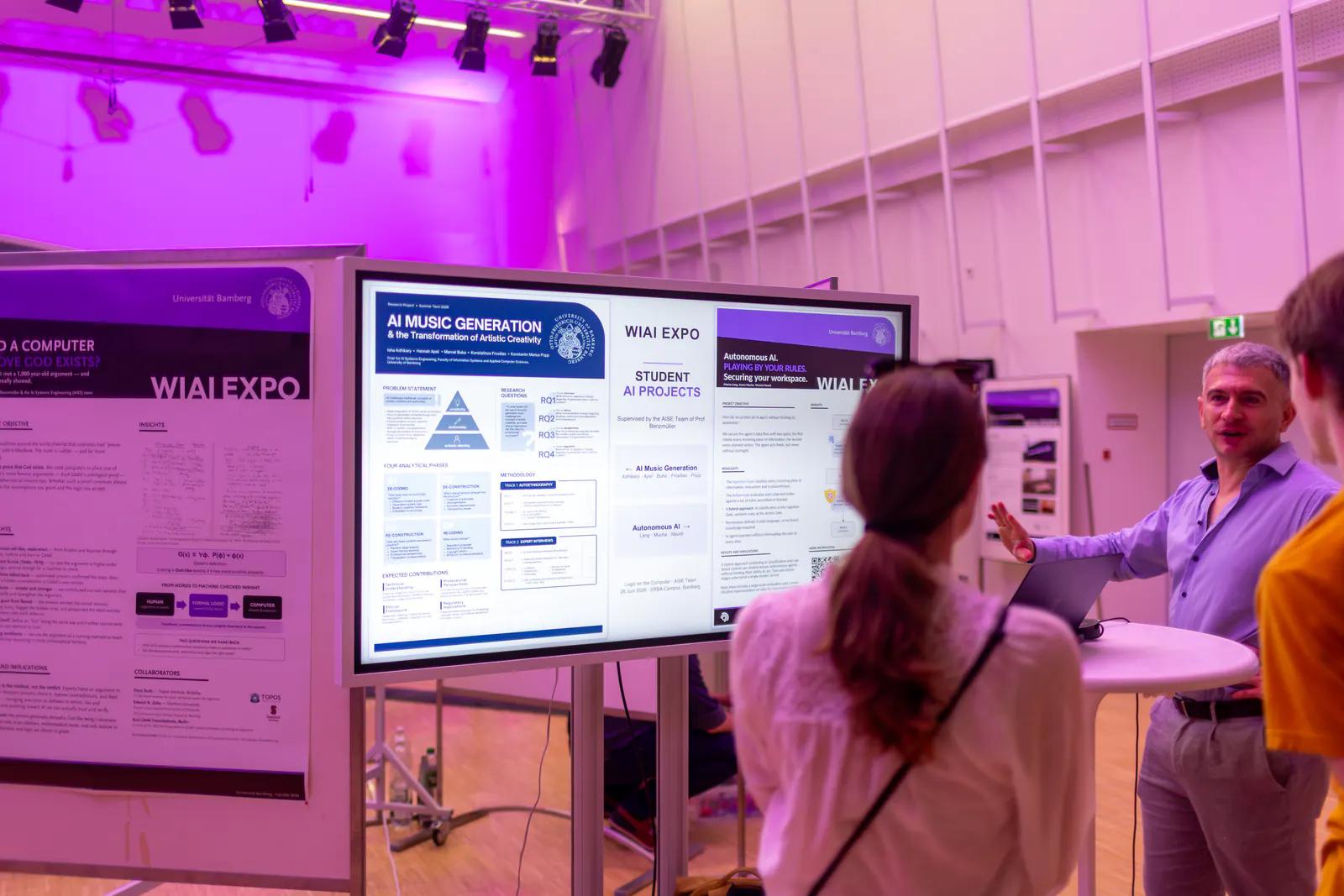
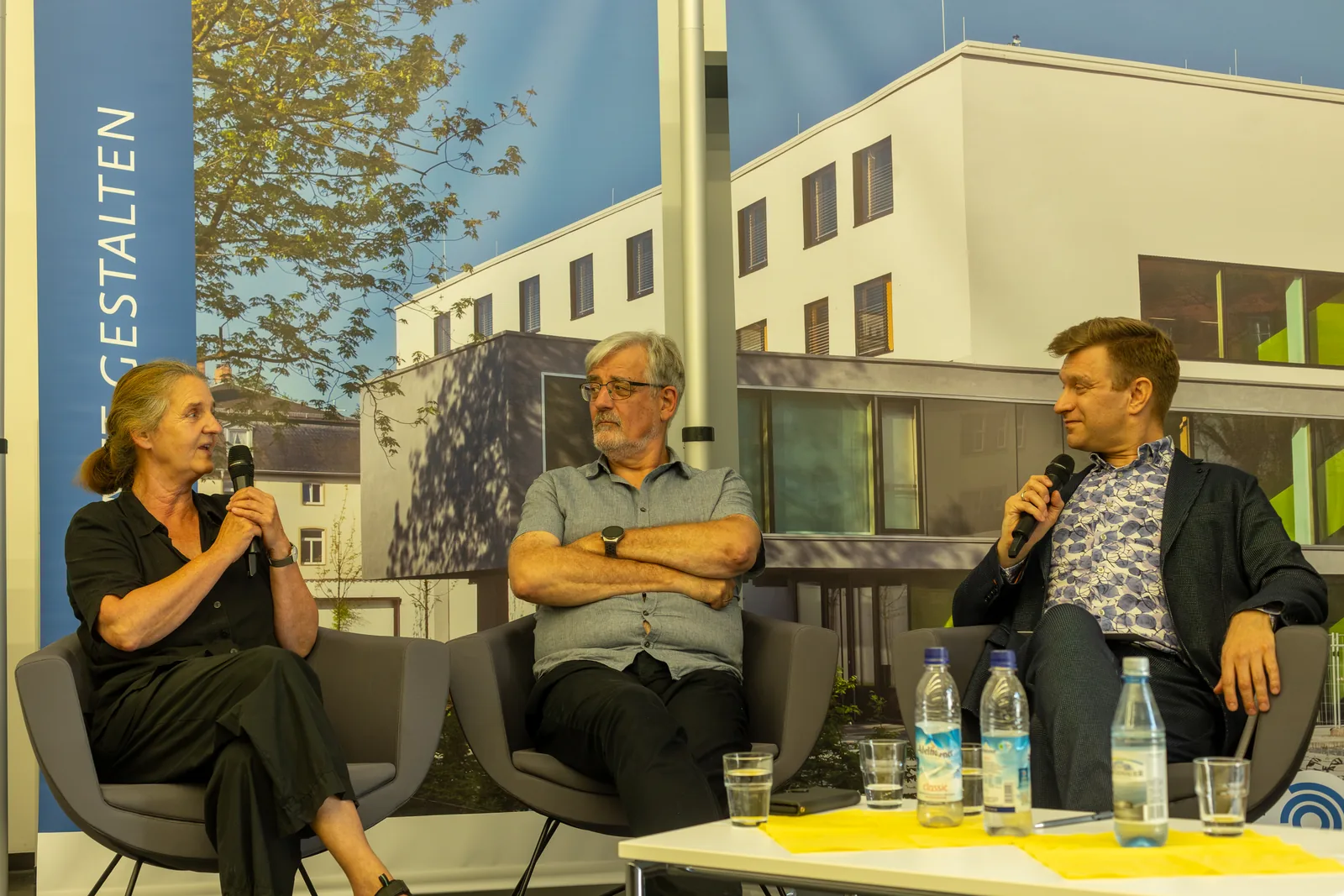
The faculty puts special value on close contact with students and on small groups in exercises, project courses and seminars. In a faculty of this size, professors and staff are easy to reach, also outside their weekly office hours.
An international programme
The programme is taught in English. You can take part in international research projects and spend a semester at a partner university abroad.
An internship to try out a career
An internship in a company is optional. It shows you possible jobs, and the faculty’s Career Service helps you start your career.
A modern building in a World Heritage town
The faculty is based in a modern building on the ERBA island, which it moved into in 2012, with modern lecture halls, seminar rooms and labs, and a library. Bamberg offers leisure and culture for every taste.

“Bamberg is the best city a student can live in. And actually, the university is so nice. The atmosphere is so nice. International Software Systems Science is a really good chance for international students.”

What you will learn
Distributed software systems must be correct, secure, robust and efficient. ISoSySc teaches the advanced methods that this needs, going beyond what a bachelor’s degree usually covers.
You choose modules from three areas, with at least 6 ECTS credits in each. ECTS credits measure your study workload: the whole master has 120. A few example modules:
- Theory
- Automation of Logical Reasoning · Functional Programming of Reactive Systems
- Systems
- Operating Systems Engineering · Data Streams and Complex Event Processing
- Software
- Applied Software Verification · Introduction to Differential Privacy · Evidence-based Software Engineering
- Related fields
- Modules from related computer science fields, for example Energy-Efficient Systems or Advanced Information Visualization and Visual Analytics
Your degree
Four things that shape your two years
Specialise
In areas such as distributed and mobile systems, software analysis and verification, service-oriented architectures, or communication systems and protocols.
Work independently
You also do one seminar, one project and your master’s thesis (30 ECTS credits).
Go abroad
A semester abroad or an internship in an international context is strongly recommended, but not required. According to the faculty, almost a third of all Bamberg students spend part of their studies abroad.
What you can do afterwards
Analyse problems of the field on your own with scientific methods and contribute professional solutions to complex computer science problems. Talk about technical topics fluently in English and organise yourself in international teams.
How your 120 credits are split
Five module groups, on a scale from 0 to 120
All module groups are electives. The bars show how much of your 120 ECTS credits each group can take up. The dark part is the minimum, the light part is what you can add.
Scale: 0 to 120 ECTS credits.minimumpossible on top
International Experience and the study rules
International Experience
You collect 12–27 ECTS credits from three options: study abroad (0–27 credits), an internship in an international context (12 credits) and foreign language modules (0–15 credits, not English and not the language of your school-leaving certificate).
If you completed your first degree entirely outside Germany, you can also do the internship at any company or research institution in Germany. You look for the internship or the place abroad yourself. For study places abroad, the International Office helps through the university’s partnerships, but there is no right to a place.
Before you go abroad, you agree with the examination board (the faculty committee that decides on admission, exams and recognition) which modules you will take there. This agreement is called a learning agreement.
Study progress
The standard period of study is four semesters, the maximum is six. You can retake failed module exams as often as you need within that time. You can repeat the thesis once. There is one check you must pass: at least 18 ECTS credits in Software Systems Science by the end of your second semester, and at least 30 by the end of your fourth.
Specialisation on your certificate
On request, one of the three areas can be shown as your specialisation on your degree certificate.
The rules in full
Study and examination regulations (StuFPO, German, PDF) · Module handbook (PDF)
The faculty also offers an unofficial English translation of the regulations (PDF); only the German version is legally binding. Sample study plans show how your studies could look if you start in the winter semester (PDF) or the summer semester (PDF). They are examples only: you choose your own electives.
Your contacts
ISoSySc has its own programme coordinator, its own study advisory service and its own helpdesk.

Tim Kipphan
ISoSySc helpdesk
The first point of contact for general, organisational questions about the programme: helpdesk.ma-isosysc@uni-bamberg.de
- Structure and content of the programmeProf. Michael Mendler, programme coordinator: he coordinates the programme and is the main contact for fundamental questions about it.
- Choice of modules and your study planStudy advisory service: studienberatung.ma-isosysc@uni-bamberg.de
- Application and enrolmentRegistrar’s Office: master.studierendenkanzlei@uni-bamberg.de
- After admission: housing, visa, first stepsMaster Welcome Center: master.welcome-center@uni-bamberg.de
- Not sure whether ISoSySc suits you?Write to the faculty in English.
Where it can take you
Career fields
Graduates can work in these areas
Software development and consulting
Planning and building large software projects, or IT consulting.
Software architecture
The faculty says that IT service providers, but also medium-sized to large companies, urgently need software architects.
IT infrastructure
Developing and running it: from transaction systems and server infrastructure to web portals and cloud providers.
Research
The programme is research- and project-oriented. It prepares you for research and development in industry, or for further research work towards a doctorate (PhD).
On the way
While you study
Meet employers at the faculty
Every summer, the faculty’s career day brings students together with about 20 companies, from Bamberg IT firms to international IT corporations. Its supporting programme, such as application training, was held in German in 2026. The next career day is on 16 June 2027.
An internship abroad
Through the Career Service’s Corporate Internship Program you can do an internship with a partner company abroad, for example Tata Consultancy Services in India or Intelligent Banker in Denmark. Whether it counts towards International Experience is decided by the study advisory service.
Work while you study
With a work permit, you may work up to 20 hours a week during the lecture period. The rules depend on your residence permit: see the Master Welcome Center’s FAQ.
After you graduate
Time to find a job in Germany
Up to 18 months
If you are not an EU citizen: after you graduate from a German university, you can get a residence permit for up to 18 months to look for a job, if you can show that you can support yourself during this time. You may work during this period.
Living in Bamberg
Bamberg has about 80,000 inhabitants: big enough for variety, small enough to find your way quickly. Its old town has been a UNESCO World Heritage Site since 1993.
Applying
The essentials first. The full rules are behind each “details” link.
At a glance
Degree, deadlines and costs
- Degree
- Master of Science (M.Sc.), 4 semesters, 120 ECTS credits
- Language
- English
- Format
- On campus in Bamberg. There is no online or hybrid teaching, and exams take place in Bamberg.
- Start
- winter semester or summer semester
These deadlines are set in the study regulations.
Costs
- Semester contribution (paid by every student): €123.22 per semester, including a semester ticket for public transport. There are no tuition fees.
- Application fee: €60 for most applicants without EU/EEA citizenship (European Union or European Economic Area).
- Living costs: the university’s Welcome Center suggests budgeting €900 to €1,000 per month, of which rent is €350 to €500.
What you need
Your degree, then one of two ways in. Dashed: only for some applicants, or later.
with a standard period of study of at least six semesters and 180 ECTS credits
or
and at least 115 ECTS credits of matching content:
- at least 34 in mathematics, theoretical computer science or formal software analysis
- 33 in programming, software engineering or algorithms and data structures (your bachelor’s thesis can count)
- 36 in systems (databases, computer architecture and operating systems, security, distributed, interactive and mobile systems, data communication)
- 12 in further mathematics or computer science
In addition
or an equivalent certificate
if your degree is from outside the Lisbon Recognition Convention states and your grade is worse than 1.5
proof needed by the end of your second semester
Grades use the German scale, where 1.0 is the best grade. The examination board checks during your application whether your degree counts as the same field of study, and decides case by case whether a programme counts as related.
Details: grades, early start, English, GRE, German
Your degree and grade
You need a university degree (or an equivalent one) with a standard period of study of at least six semesters and 180 ECTS credits. Your overall grade must be 2.7 or better in the same field of study, or 2.0 or better in a related degree programme in computer science. The examination board (the faculty committee that decides on admission, exams and recognition) checks during your application whether your degree counts as the same field of study, and decides case by case whether a programme counts as related.
The Registrar’s Office (the university office for applications and enrolment) converts foreign grades with the modified Bavarian formula: x = 1 + 3 × (Nmax − Nd) / (Nmax − Nmin). Nmax is the best and Nmin the lowest passing grade of your system, and Nd is your grade.
Still finishing your bachelor’s degree?
If you will meet the requirement for a degree in the same field, you can start before you graduate. You must be able to show at least 150 ECTS credits when you enrol (register as a student).
You must then prove that you have completed your degree by the end of your second semester. Your admission letter states the date by which the Registrar’s Office needs your certificate. Otherwise you will be removed from the register of students.
English
You need at least IELTS 6.5 or TOEFL iBT 90, or an equivalent certificate. The German Abitur is accepted as equivalent.
Language test certificates (IELTS, TOEFL etc.) must not be older than two years when you apply. A letter from your university saying that your studies were taught in English is not enough.
GRE or GATE
GRE and GATE are standardised tests. You need one of them if you completed your degree outside the states that signed the Lisbon Recognition Convention and your overall grade is worse than 1.5 (German scale). Then you need the GRE General Test (at least 153 Verbal, 164 Quantitative, 4.0 Analytical Writing) or GATE (at least 500).
Send your GRE scores using the university code 1563.
German: not for the application, but for enrolment
You do not need a German language certificate to apply. For enrolment, however, you need proof of basic German (level A1).
German A1 is required by the end of your second semester
The university’s enrolment regulations require basic German (level A1) for programmes taught entirely in another language. You can hand in the proof until the end of your second semester. Until then you are enrolled for two semesters only. Without the proof you will be removed from the register of students.
The accepted forms of proof are listed in the appendix of the enrolment regulations (German, PDF). One of them is a certificate from the examination board of your programme.
Once you are enrolled, you can take German courses at the university’s Language Centre.
When
From the application to your first lecture
- mid-Nov / mid-Mayapplication portal opens
- 15 Jan / 15 Julapplication deadline
- decisionin the application portal
- enrolmentby post, within the period in your letter
- 1 Apr / 1 Octsemester begins
Portal opening
The online application opens in mid-November for the summer semester and in mid-May for the winter semester.
Summer semester 2027
The Registrar’s Office will publish the link to the application portal in mid-November 2026.
Apply early
Checking a foreign degree takes time: plan at least ten weeks. The visa procedure usually takes another eight to twelve weeks. Add time to find a room and to travel.
How to apply
Four steps
- Apply online in the university’s application portal and upload your documents. Bamberg does not use uni-assist. Online application form
- Pay the application fee if you are not an EU/EEA citizen: €60, paid online via ePayBayern (Visa, Mastercard or PayPal). Pay as soon as you submit your application and upload the receipt in the portal. The payment takes about three to four days to reach the university, and your application is processed only after that.
- Wait for the decision. The Registrar’s Office checks that your application is complete and passes it to the examination board, which decides on admission. You receive the decision in the portal.
- Enrol by post at the Registrar’s Office within the period in your admission letter. There is nothing to accept: if you decide not to come, you do not need to do anything.
Foreign certificates are not checked in advance (for example by email). They are only checked as part of a complete application that you submit on time.
Documents for the application and for enrolment
For the application
The portal asks for the exact documents, which depend on your nationality. Usually these are:
- CV
- school-leaving certificate with grades
- university certificates with transcripts of records. Documents in a language other than German or English need an official translation into German or English, made by a sworn or court-approved translator or by an authorised department of the university that issued them. Translation agencies without sworn translators are not accepted.
- passport or ID card
- English certificate, and GRE or GATE results if they apply to you
- APS certificate (issued by the Akademische Prüfstelle) if your degree is from China, India or Vietnam. For Mongolia, please ask the Registrar’s Office.
Only complete applications are assessed.
The Registrar’s Office lists the required application documents and the country-specific rules (German).
For enrolment
To enrol, you send officially certified copies of your foreign certificates and their translations by post. A certification needs a certification statement, the certifier’s signature and an official seal. Town halls, notaries, and embassies or consulates can certify. Lawyers, savings banks, health insurers and churches cannot, and translators cannot certify copies of originals. Do not send originals: the documents are scanned and then destroyed.
You also need health insurance. A German statutory health insurance fund must report your insurance status to the university electronically, even if you are insured privately or through your home country.
Costs in detail
Fees, exemptions, refunds
No tuition fees
You pay a semester contribution (currently €123.22 per semester), due at enrolment.
Application fee
€60 per person and semester for applicants without EU/EEA citizenship. If you apply for several programmes in the same semester, you pay only once.
Who does not pay the fee
EU/EEA citizens do not pay the fee, nor do applicants with an Abitur or a bachelor’s degree obtained in Germany.
No refund
The fee is not refunded. If you do not take up your place and apply again for a later semester, you pay the fee again.
Questions about the fee, including special cases: applicationfees@uni-bamberg.de. More on the application fee page.
Visa and arrival
After your admission
Visa
Most international students need a student visa. You apply for it at the German embassy or consulate in your home country before you travel. A tourist visa cannot be converted in Germany. Citizens of the EU/EEA and Switzerland do not need a visa. Citizens of some other countries can enter without a visa and apply for a residence permit in Bamberg after arrival: see the list on the formalities page. Binding information is only available from the German mission abroad.
Be in Bamberg when lectures start
Only enrol from abroad once you have your visa and know that you can arrive on time. Otherwise the faculty strongly recommends moving your start to the next semester. No late arrival letters are issued for ISoSySc.
If you will be late, contact the Master Welcome Center early. If you are not yet enrolled and have no confirmed visa appointment, you apply again for the following semester (and pay the application fee again).
Proof of funds, housing, registration
Proof of funds
For the residence permit, the immigration office in Bamberg accepts a blocked account, a formal declaration of commitment, an employment contract with your last three pay slips, or a scholarship. Each must cover at least one year. For the required amount, see the Federal Foreign Office.
Housing
The university has no halls of residence of its own. Once you are admitted, apply directly to the providers. The largest is the Studierendenwerk Würzburg (the student services organisation). Start your search early.
After arrival
Register your address at the residents’ registration office within two weeks. If you are not an EU/EEA citizen and your visa does not cover your whole stay, apply for a residence permit at the immigration office in good time (waiting time at least eight weeks).
Step by step
The Master Welcome Center’s pages for international master’s students and the formalities page explain these steps in detail.
Safety and support
And whom to call
Statewide, Bavaria has the lowest recorded crime rate of Germany’s 16 federal states: 4,371 offences per 100,000 inhabitants in 2025, compared with 6,591 nationwide (police crime statistics).
According to the DAAD (the German Academic Exchange Service), Germany is one of the safest countries in the world. In a 2021 survey, over 80% of international students said they feel safe here. That does not mean nothing ever happens. In an emergency, call the police on 110, around the clock.
If something does happen, you are not alone. The university has trained contact persons for confidential advice on sexual harassment and violence (sbg@uni-bamberg.de). Its Anti-Discrimination Office is at An der Weberei 5, the faculty’s building, and advises in German and English (antidiskriminierung@uni-bamberg.de).
The faculty’s equal opportunities team (wiai.gbwiss@uni-bamberg.de) runs a women’s network, Frauennetzwerk WIAI. Nightline Bamberg is a listening line run by students for students that you can also call on your way home. The national helpline for women affected by violence is 116 016.
Questions?
Write to us in English. We pass your question on to the person responsible for ISoSySc.
More about the faculty, the town and the people: what studying in Bamberg is like.